Saturday, 16 August 2014

Winter wrap up

Its cold outside Spring is just around the corner.......

Last week I sowed my summer seeds and my girls are back laying (and letting me know very noisily all about it)

In the meantime my winter garden is still ticking along. At home I am picking bok-choy, sprouting broccoli   and a sneaky winter capsicum (I think its the my personal record for latest harvest capsicum). To add to that, a few weeks ago (before it got too frosty) I picked a handful of pink cherry tomatoes from the community garden and let them ripen in the banana bowl.


It's my first winter with a plot at the community garden and my plants have been going well out in the sun.

Last week I thinned my first baby leeks for pumpkin and leek risotto.


My garlic is growing well and I am confident of some nice big heads.


Japanese daikon- are bursting out of the ground- quite literally! Stay tuned for another installment where I attempt to turn these babies into Japanese pickles (starting off my 'nukadoro'- rice bran pickle pot is my next project on the list).


Finally, here's my savoy cabbage. Last year the cabbages in planter box ended up infested by aphids, so this looks like my first successful cabbage harvest!


Wednesday, 25 June 2014

Recycled green house

The warmest spot to sit on a winters day

Thanks to some IT issues..... seriously how hard can it be to change internet providers? its been a while since I last posted... so now we are deep in the depths of winter I am finally able to post about my new recycled green house.....

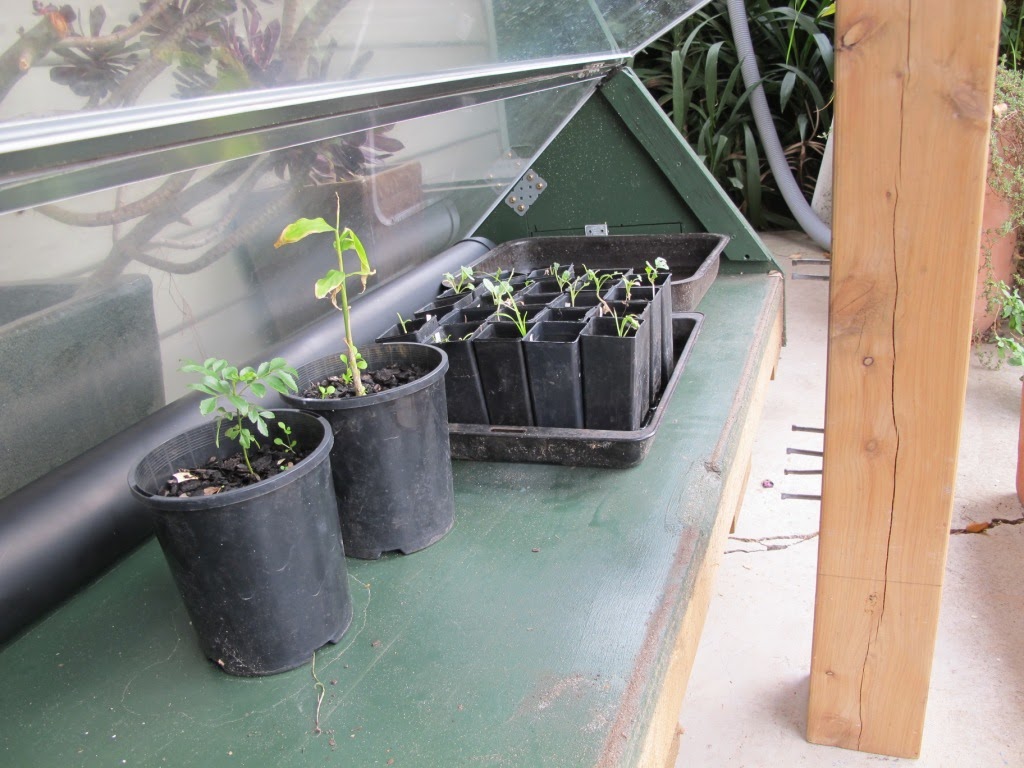
The most important part of any green house is the glass.. in this case it's the old hinged shower screen taken from our bath during the renovation.


the screen lends itself to an A-frame design which was created using left over timber and plywood. The piece of wood at the front is a prop to hold open the door. 


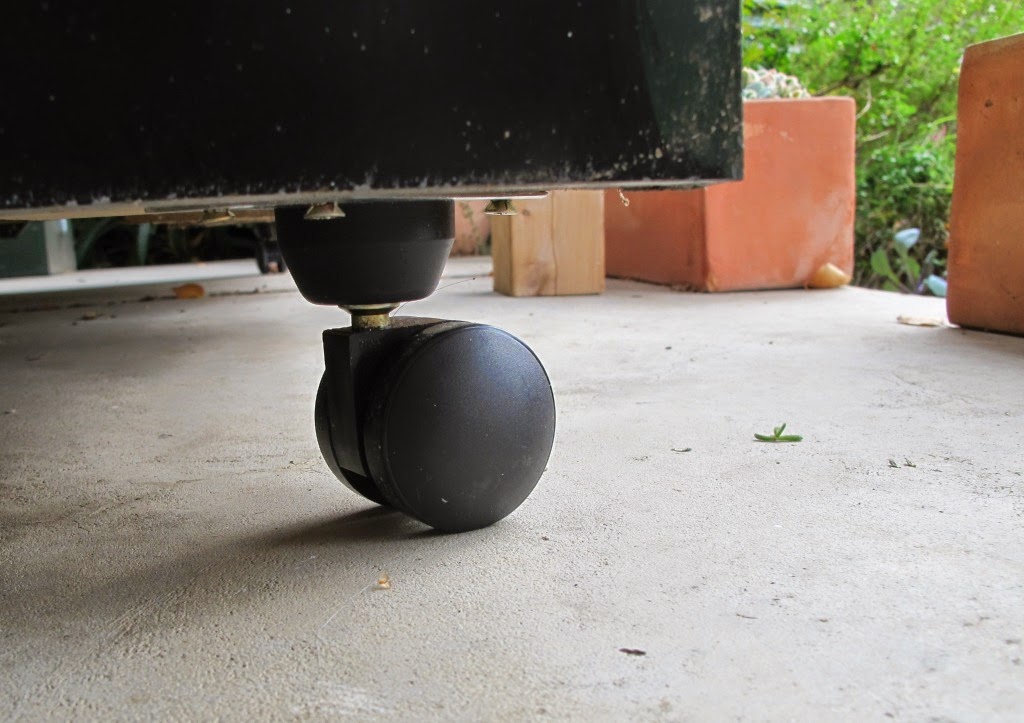
Due to the combined weight of the screen and the timber we have added  caster wheels to help move the green house around to maximize exposure to the sun. The casters were taken off a dumped mattress base that my partner G found somewhere in the neighbourhood.


Inside are the left over remains of my winter seedlings, my new baby curry tree and a piece of spouted ginger. In addition to help maintain the thermal mass G added a piece of  water filled PVC piping, spray painted black.Once again this was recycled from a previous down pipe diversion that we no longer needed once the water tanks were installed.

 Not long to go before I test it out for real with seed sowing for summer.


Monday, 5 May 2014

Work versus 'work'

Having just spent the last few weekends and the period in between Easter and our Anzac Day public holiday (another long weekend) scraping, sanding and painting my way through the last of our bathroom and laundry renovation (thankfully we had professionals do the rest of it!), I can confirm I won't be auditioning for any home renovation shows soon. After about day 4 of trying to strip of 80 years of paintwork off the bathroom window I have decided if I have to do manual labour I will stick to the garden and looking after 'livestock'. Anyway in between it all I somehow managed to get my garden under control and hopefully ready for winter- so hopefully now there's more time for sitting back and other activities like blogging.

Its funny how the time spent out in the garden digging, weeding and collecting chicken poop for the compost bin doesn't seem like work to me and painting does.... but my increasing efforts to grow and expand the productivity of my own garden and to take on additional growing space is paying off!  This April I have met my challenge and included homegrown food on the table for every day in the last month! (apart from a few days when we have eaten out with friends etc). Last year I came pretty close but this year there was a lot more variety and multiple ingredients.

A summary for the top ingredients for the month of April is as follows:

  • egg plants
  • capsicum
  • tomatoes
  • beans
This year these mini heritage eggplants that I grew from seed saved from last years fruit (my first successful attempt to germinate eggplant seed) were my best yielding eggplants. I have mostly been including in various versions of Thai style curry and combined with my regular 'Lebanese' eggplants to make 'Chinese chilli' eggplant' with free range pork mince.

Italian heirloom- Listada Di Gandia - from 'Diggers' seedling stock 
Here are the very last of some sad end of season tomatoes- no good for salad but can honestly say there's no way you can tell the difference in the flavour after they have been slow cooked with a pork shoulder for a couple of hours and popped into a tortilla from our local yet authentic 'tortilleria' called La Tortilleria.

Sad tomatoes- the yellow ones have me stumped- they refuse to turn any shade of red- but seem ripe as is. I didn't knowingly plant any yellow varieties?

Its been a big month for Mexican with my first attempt to grow and harvest tomatillo, a massive success! I have yielded a couple pf kilograms from my two plants at the community garden patch. I have seen them  for sale for $19.99kg at gourmet grocer at the Vic Market. My girlfriend and I are therefore seriously contemplating whether we turn the community garden plot into a tomatillo farm. Last year I posted a recipe for tomatillo green salsa which I have subsequently found not only makes a great topping for tacos, but also for poached eggs and as a spread inside ham and cheese toasties- YUM! other friends have been experimenting as a topping for pork chops and in a 'vegan' Mexican dish..... 


A bowl of tomatillos, 'surprise' padron chilli and the finished salsa.

I think May could be a more difficult month than April- as I am waiting for winter crops to come on board. Thankfully I still have the last of the eggplants, heaps of capsicums and chillies and tomatoes in the freezer. The beans (that went in late) are showing no signs of letting up yet and I have one hen still laying for now!

Sunday, 6 April 2014

Breaking the rules

Ok so the theme of this post is about breaking the rules

1. Thou shall pull your tomatoes out right about now?!

It seems everyone is busy pulling tomatoes out. Am I the only one who's hoping mine will linger on a little longer? A few weeks ago I got an email from my one of my planter box neighbours to say that she had noticed that the tomatoes I had put into the planter box that had been abandoned by its original owner had been pulled out and replanted. My neighbour was curious as to who had taken it over. Turns out it wad another neighbour N who 'thought it was time to pull tomatoes out and plant winter vegetables'. Never mind I was hanging out for my last batch of yellow pears that were hopefully only one more 29 degree day away from ripening. Over at the community gardens I can sense the old guys getting tetchy because the weeds are coming up between my tomatoes there. With days in the last week hitting the 30s I will leave them for the next week or so before I bite the bullet!

April tomatoes and a leek from last year that's taken this long

2.Crop rotation versus use of micro climates

Gardening rules 101 talk about the principal of crop rotation. Beginners gardening books feature nicely drawn diagrams of how to rotate your crops between nicely arranged square beds. The problem with this is that it assumes you have access to each bed with the perfect conditions for each kind of plant. My original garden bed runs along my southern boundary (12m x 2m), with the sun/shade patterns moving the sunniest areas throughout the year. The soil on the western end is sandy as a result of imported  top soil whilst the soil at the eastern side is the original heavy clay. As a result I have never really been able to rotate my crops in any significant way because certain things grow better in certain spots.  Moving things around for the sake of 'rotation' seemed to create less results than keeping them in the same spot with the bests conditions for that particular plant year after year. Now that I have opened up new growing options that should allow rotation I am still finding other issues over-riding crop rotation. Differences in sun, heat, soil, pests (harlequin bugs), pilfering rats, chooks and neighbours will be guiding my planting schedule over the coming year. For the winter I have decided the focus of my backyard will be on plants that are regularly picked- leafy greens, peas and broad-beans. I am moving root veg- daikon, leeks, onions, garlic and parsnips out to the community garden and using the planter boxes and laneway for back up brassica crops- (away from chooks- see rule 3)

My back lane has performed well for heat loving plants- like these 'capsicums' (urmmm surprise padron chilies) and my first baby bitter melon)  


3.Disobedient chooks- Rule: don't keep chooks in the same space as your edible plants-

The impacts of this form of rule breaking goes without saying. There is a simple reason why your average chook yard is a dust bowl. Mama hen 'Boss' has recently figured out a new way to 'pull' the wire fence so the pegs holding the fence panels together come away and she can squeeze in. As a result my late crop of climbing beans is now one significant plant down.

Sunday, 2 March 2014

The tomato project part three.

Ok so its well over a month since my last update on my tomatoes. So much for my idea of providing regular updates on on my 2013-14 harvest. In a quick round up here's whats been happening in each of my growing locations:

Street planter boxes:

The planter boxes have been what's keeping my salads stocked over the summer. I have ended up with 2 yellow pear and 2 regular cherry tomato plants that have been producing a couple of punnets worth per week.


I also have a mini roma (which suffered from blossom end rot early in the season and is only started to ripen unblemished fruit) and this large unknown variety (below), Its one of the varieties from Bek's seed collection and whatever it is, the tomatoes made a fantastic rich sauce for my pasta the other night!


Backyard:

The rats have come back and have been busy stripping all the cherry tomatoes from along the back fence. We have recently started trapping again and I tried some mental deterrent for the rats by placing a small bit of the cats poo (relocated from the chooks dust bath pit URGH) on the fence railing that they use as their entry point. To date both deterrents have failed.

Community garden plot:

The hopes and dreams of my community garden plot tomato crop have largely now faded thanks to a plague of harlequin bugs that have pretty much taken over. They seemed to have dropped off over recent weeks but its now too late to rescue any kind of serious harvest. Here's a selection of harvested tomatoes showing the little white spots indicating harlequin bug damage. Basically it seems that by sticking their sucking mouth parts in into the flesh it encourages the development of a thickened skin. This doesn't make tomatoes conducive to salads so I pretty much chop them up and freeze or use straight away in any dish that calls for a tin of tomatoes.


I am wanting to find out more about the harlequin bug life cycle with a hope of finding out if there is anything that can be done to stop their development because nothing seems to kill them. Information seems very thin on the ground. In the past I have tried sprays both natural (garlic,chili) and chemical (yep I was really that desperate to get out the Confidor spray). Recently I have tried drowning them in a spray of soapy water- I reckon that kills about 10% them,  but even then I am not sure if its real death or suspended animation until they dry out.  Based on my observations I wondering if they need undisturbed soil or mulch to commence their life cycle as they have been very much absent from my garden since I introduced my chickens. Either way any subsequent harlequin plague may be a deal breaker for my continued participation in the community garden next year.

Thursday, 23 January 2014

Weird and wonderful

One of my favourite parts of growing my own veggies is experimenting with lesser known plants that go beyond your normal standard beans, tomatoes, eggplants and chillies. Luckily for this article most of the plants I have been meaning to feature here have miraculously survived the extreme heat we have had in Melbourne last week. So here goes a list of my top unusual edibles.

Japanese Burdock.

I usually refer to this by its Japanese name 'Gobo'. I came to know this vegetable on my trips to Japan including two years living there. I got my original plant from a Japanese native, Melbourne resident and avid back yard gardener who was selling plants at the annual Box Hill Japanese Festival.

The edible part in Japan is the root. There are various methods to encourage the growth of a single straight ridiculously long tap root using poly tubes etc. But I am lazy and just grow it in a pot and work around the wonkyness of what ever grows. (Based on my experience do not attempt to grow in the ground unless you have very sandy soil or you want to excavate half the garden to get the root out). The plant is a bi-annual that dies off over winter and seeds every second year. The leaves are quite tasty and subject to attack by various pests- including large patrolling feathered variety. The leaves grow large and broad so it needs a lot of space to grow. Based on these factors I am growing them in a dedicated planter. The seeds are prickly and sticky so will end up stuck to you and your pets! (Apparently they were the inspiration for velcro!).  My main use for burdock is to saute with carrot, sesame, mirin sugar and soy sauce. It has a fantastic nutty taste.

Japanese burdock (looking a little wilted from the heat)

2. Tomatillos.  

This is my first year growing tomatillos from seed I saved from tomatillos sourced from the Gasworks Farmers markets, so I have no idea what the outcome of this experiment will be.  Wikipedia tells me you need more than one plant to germinate fruit. I have two plants that are looking fantastic. Last year I made green salsa from my purchased tomatillos.

tomatillo plants


Bitter melon. 

This is another experiment inspired by my travels in Japan, to Okinawa where 'goya' (as its known) is the national dish (Okinawa is currently politcally part of Japan- but culturally and ethnically quite different). This is my second attempt to germinate and grow goya (it needs warm weather) but in my first attempt it was too late in the year to flower and fruit. The birds killed one plant so I am sowing more seeds in case it needs cross pollination.

bitter melon seedling

Water chestnuts.  

These were gifted to me by a work colleague as a single plant/ corm last year. The plants need to be submerged during the warmer summer months and are harvested when they die back and dry off in the autumn. I am looking forward to my first harvest later year and am planning a water garden (water cress and water chestnuts) in my soon to be removed bath (renovations are about to kick off) next spring.


water chestnuts


Thursday, 9 January 2014

The tomato project- Part two 'Going Pear Shaped'

At last my first tomato for the year....

And the winner is a 'yellow pear' variety

Harvested on Tuesday 7 January- that has to be a record for tomato harvesting lateness?

This little one was harvested from one of the tomato plants I popped into an empty spot in one of the street planter boxes way back in August! I thought that would be way too early, but it seems to have worked,

The fact it was a yellow pear in that planter means something strange has definitely gone on with my seed sowing? There are little baby pear shaped tomatoes springing up everywhere! in the planters and in my back garden.


It's strange because last year I got two spindly little 'yellow pear' plants very late in the piece from our local veggie swap. They were soon swamped and over-shadowed by the standard cherry tomatoes- (I call them 'feral cherries' because they seem to spring up everywhere). All in all I must have harvested only about 3 or 4 'yellow pears' last year. One of which I kept for seed. Normally the way this works is that I take the seeds and spread them onto a piece of paper towel. I write the name of the variety on the paper towel fold it in half an put it on the window sill to dry for a few days or so. After that I pop the piece of paper with the seeds still stuck to it into an envelope, maybe with a couple of other folded up pieces. When it comes time to plant the seeds I peel each seed gently off the paper. It's amazing that so many seeds from just one tiny tomato have managed to grow and I am pretty sure they were supposed to come from the piece of paper that said regular 'feral' cherry so I am thinking that in some stage of  the process the yellow pear got mixed up with the 'feral cherry'. I am wondering even if they have cross pollinated? I will find out when the others ripen.

In other tomato news down at the community garden plot where I am testing Bek's varieties the only ones that appear to have fruit at last count were the Ned Kelly and the Big Beef. With hot weather finally on the way I am looking forward to some more tomatoes soon.


Tuesday, 24 December 2013

Garlic fail - part two..... the pre Christmas postscrip.

Last month I posted about my sad little garlic harvest...... I was little ashamed to mention the postscript to this story, thinking it was a reflection of my poor garlic husbandry skills.

A week or so after pulling the garlic I had it all on in a tray drying in my living area. I could small a strong garlic odour but wasn't too concerned as normally, when its not so damm cold and miserable I dry it outside in our covered BBQ area (which is on the south wall of the house) where I assumed the smell would dissipate. The smell went on for the rest of the busy week until I decided to sort and separate what was worth eating from the smaller cloves that I intended to put back for another year. Much to my dismay I found that half the heads felt empty inside. The cloves themselves had shriveled and gone almost butter-like in texture.  Most of what little I harvested was now apparently ruined. I assumed it was some kind of bulb rot and put most of the affected cloves into the worm farm.

Fast forward to pre Christmas preparations at the Gasworks Farmers Market collecting my free range ham from Bronwyn and Michael at Gypsy Pig. On my round of the market I purchased a bag of garlic and got chatting with the farmer about my garlic incident. He immediately diagnosed the cause.... I had sun burnt my garlic! After I pulled out the garlic it was a little damp so I left it on our outdoor table for a day before I brought it inside. Apparently 15 minutes in the sun is enough to do it- so a few hours and I had essentially cooked up my cloves. Who would have thought. Oh well lesson learnt. It won't happen again and I am feeling a little less insecure about my garlic growing skills- rather it was my garlic harvesting skills that were more of a problem!


Thursday, 12 December 2013

The tomato project -part 1

My tomato patch at the community garden
It seems ages since I have had a decent crop of tomatoes. I have to swing my mind back 13 years to a rental share house on the other side town where it seemed like magically with little effort we just had buckets of them -quite literally. Here at my current home, the past few years have not been kind to my tomato growing efforts. Throw in climatic factors; too hot, too cold; not enough rain; too much rain (Melbourne's erratic weather),  lack of full sun and my experiments (pre-chook days) with perhaps a bit of an overdose on worm castings and worm wee that yielded huge green plants but little fruit,  its been a long time since my last bumper harvest. Last year for the first time I had a decent crop ready to ripen but that disappeared thanks to a boom in the population of the local rats.

This year,back in the depths of winter, I decided to get organised a set up a tomato growing strategy. It started with Bek's call out to help her clear out her seed collection. It was very exciting to receive in the old fashioned post a beautiful envelope containing neatly labelled plastic zip-lock bags with the following selection:

  • Ned Kelly
  • Big Beef
  • Champion
  • New Yorker
  • Mortgage Lifter
  • (and most intriguingly) Big White Pink Stripe (lets call that BWPS).

To that collection I added two kinds of cherry, Yellow pear and some Mini Roma. The cherry tomatoes included a small sweet tomato I took from the planter garden (variety unknown) and what I refer to as feral cherry- the cherry tomatoes that seem to crop up everywhere around the garden. Unfortunately due to an accident during seed sowing the Mini Roma got tipped into the BWPS so its going to be interesting to see what grows where.

My first step back in July was sowing a few of each into strawberry and tomato punnets. These act as perfect mini greenhouses out on the front porch in the northern winter sun. The punnets were lined up in a kitty litter tray so they could be bought inside and put in front of the heater at night. That technique seems to work and I got excellent germination. Once the plants had their first sets of decent leaves I planted them out into single tubes or two by two into small pots.

Having grown far too many seedlings for my own use (I have kept 2 of each of the standard varieties) I sold seedlings off for a gold coin donation at work and at a little stall I set up for an hour and a half as part of the Garage Sale Trail Day (basically this was an event encouraging everyone to have garage sales that offered me the chance to publicise my sale via a listing on the website). With very little effort, my combined sales of excess chilies, eggplants and capsicum came to $52 which has been donated to Oxfam to help fund local food growing programs in East Timor.

This year with my expansion out into a community garden, I have shifted the focus on my backyard beds leaving only cherry varieties in the backyard. There are numerous cherry plants filling out the various pots and tubs and a row of the 'feral' variety lined up on the back fence. Yellow pears and either mini roma or BWPS are out in the planter boxes and a full plot of standard tomatoes in the community garden plot. Not content with that I have planted out all my left over seedlings in the adjacent plot that seems to have been abandoned. I am hoping with any success the community garden will be so overrun with tomatoes that the crop from that bed can be distributed to one of the many community or refugee  groups that could use donations of fresh vegetables. Stay tuned to see how it all works out!


Saturday, 23 November 2013

Garlic fail!

A few weeks ago I read with trepidation  Liz's post on Suburban Tomato about her unsuccessful garlic harvest. For some weeks I had been watching the rather pathetic garlic stalks in my garden whither away (not helped by the odd  "naughty chook got BUSTED in the garden stampede") knowing that the day would soon be coming where I would  need to soon take the plunge and dig them up.

Last Saturday was that day..... and here are the results of my entire garlic harvest.......


Unlike Liz I don't necessarily use my best cloves its more a case of what happens to be left over and sprouting at the end of the season. Never the less I swear on the whole the cloves have still managed to end up smaller than when I put them in.

In the past I used Chinese garlic because that's all there seemed to be around (you can see there is still some white garlic which I think dates from that time). For the past two seasons I have added in organic purple garlic that I have picked up from Farmers Markets.

With this being my second year with a less than bumper harvest I have been interested to see what other people think might be the problem. Last year I am sure I read a similar post on Liz's blog where readers mentioned that garlic needs lots of food. So in preparation this year I dug mounds of chooky goodness (composted manure and wood shavings) a few weeks prior to planting. Throughout the growing season I also gave the plants the odd dose of worm wee.... mmm so maybe it's not nutrients after all.

My second idea is that it's about water. I am thinking well watered draining soil might be the best. I am growing my garlic in fairly heavy clay type soil so its a real balancing act to keep the soil wet but avoid water- logging and rotting the bulbs. I am putting it out there in a totally non scientifically tested way that the water balance is most important right about the time the growth is highest before the plants suck all that nutrient back into the bulb. That was right about the time I went away and the whole bed ended up a little dry.

My third idea is that garlic needs 100% sun. I am going to struggle in the yard with proving this, so to test out this theory I am going to plant out some of the bulbs in the planter and my new community garden plot. Stay tuned for this time next year for the results.

Saturday, 26 October 2013

Coming back

Well I have been away from this blog and away from home on my jaunt around Central/ South America. I spent the best part of the week in Costa Rica pitching my 'Bottles to Boardwalks' project to the good folk at G Adventures  at the "Summit in the Jungle" (you can read about it here and here). While I didn't win the $25,000, I am keen to not let my idea die....so watch this space. Costa Rica was followed by the opportunity to extend my complimentary ticket over to that side of the world by joining a G Adventures 7 night cruise (not sure if that's the right word- safari on a boat perhaps?!) of the Galapagos. This was followed by another week on the islands hanging out, getting to know the town sea lion population, catching the local inter island ferries (small speedboats with BL**DY big engines) and doing a spot of diving. Combine that with a few days of exploring the sites of mainland Ecuador (Quito and surrounds) and far too long in transit and I was back!

Backyard in the Galapagos

Coming home there is always a sense of anticipation and anxiety... will the pets be waiting, will they be happy to see us (no not really) and hows the garden ?! Slightly overgrown but a little dry was the answer to the latter. One of my girls had gone clucky and caused some grief to my Japanese house-sitter who thought she was on her last legs. But everyone and everything else had survived incident free.

Coming back there's always the issue of restocking an empty fridge- Well the fridge wasn't quite empty as expected the other half had basically ignored my instructions about the leftovers for him and the chicken necks for the cat  before he left to join me in Quito and my house-sitter bless her had clearly not wanted to throw out anything she wasn't supposed to. The month old left over milk that hadn't soured was a very bizarre mystery of science! Anyway with out having to rely on everyone's favourite (un)freshfood people or getting down to the  store with the'big red hand',  the best bit about coming back was ducking out into the garden for survival rations of Tuscan kale (cavalo nero), carrots and the last of the sprouting broccoli. (I like to think the overdose on Tuscan kale also helped make up for the significant absence of leafy greens on my Latin American jaunt).

Aside from Tuscan Kale layered in lasagna, sauteed with garlic,olives pesto and pasta, I have been adding it as a side dish (along with some roasted parsnips from the garden) to accompany my favorite recipe discovery of late. Here it is:

Slow Roasted lamb shoulder with cumin and pears
2 brown onions, skin on and sliced into rounds
1 lamb shoulder (bone in), semi-cut into portions (ask your butcher to do this)
2 tbsp cumin seed
2 tbsp black peppercorns
5 cloves garlic
2 tbsp flaked salt
1 tbsp olive oil
7 sprigs thyme, leaves only
4 beurre bosc pears, skin on and cut in half (if available, you can also use 3 quinces, peeled and cut into cheeks)
3 tbsp raw sugar
2 tbsp red wine vinegar
1. Preheat oven 160C fan-forced (180C conventional).
2. Place onion in base of a heavy ovenproof dish.
3. Trim and slightly score top of lamb.
4. Crush cumin and peppercorns with a mortar and pestle, then add garlic and salt. Crush to a paste and add oil. Smother paste over lamb, rubbing between bones as well. Place lamb on top of onions, scatter with thyme and add pear halves. Sprinkle with sugar and vinegar and pour in 80 millimetres of water.
5. Cover dish in a double layer of foil and roast for four hours, then remove foil and skim some of the fat. Return lamb to oven and raise temperature to 180C fan-forced. Baste lamb a little and cook for another 35 minutes or until golden brown.
6. Serve with braised silverbeet and couscous.
Serves 4-6
(Read more: http://www.smh.com.au/good-food/cook/greatest-hits-20130812-2rr60.html#ixzz2iiamojRC)


Saturday, 10 August 2013

Nothing like a good challenge

A part of my day job is keeping track of what's going on in the media. I subscribe to an excellent free media monitoring service- 'making environmental news' which is collated by an organisation called the Banksia Foundation. Unfortunately the 'environmental news' space is a pretty depressing space these days. Take the issue of food for example -just a sample of themes and challenges currently featuring  include the expansion of coal seam gas exploration into our most productive farmland, various reports about the challenges of feeding the planet's growing population in a world constrained by the challenges of climate change, Victorian farmers pulling up peach trees because they can't sell the peaches and the Chinese buying up another patch of local farmland. To top that all off there was a Four Corners investigation into toxic dioxins being found in common herbicides used on our farms.  So rather than get down about it all I have decided to make it a motivating force to keep up my home grown challenge....

With spring around the corner, my baby girls have started to lay and the garden and the planter boxes are starting to yield serious dividends.....

Sprouting broccoli and rapini are the current staples


my first ever  parsnips, a random carrot and more broccoli and rapini for dinner

Just like the Chinese ...... I am continuing with my own land grab....taking on my biggest expansion challenge ever......


A plot in the new Braybrook community garden. This was supposed to be a new community and food hub in one of Melbourne's most disadvantaged areas.... two years later the vision hasn't materialised and Council has given up... leaving a weed filled field with ten garden plots up to the community to deal with.... like I said a challenge.

To fill my garden beds I am cleaning out the seed drawer

A test of some really old (about 10 years old!) lettuce seeds yielded the following results:


Oh well, at least the tomatoes I scored from Bek's seed collection clean out are now happily germinated on the way to being my first Braybrook crop.

Sunday, 30 June 2013

A winter garden (?!)

A little while ago I read an excellent analogy used to compare a renowned climate scientist and his views and predicitions versus those of a local climate sceptic who constantly finds reasons why the world is not warming such as "xxx part of the world has just had its wettest, coldest summer since 1944" etc. The analogy begins with the climate scientist and the sceptic both out in the forest. The climate scientist has access to a fire tower used to spot oncoming bushfires so he climbs to the top  holding a pair of powerful long range binoculars. Over on the far horizon he can see a massive cloud of smoke coming over the hills towards them so he calls out to let the sceptic know there is a bushfire on the way. Down on the ground all the sceptic can see are some trees "no fire here, lets get on with out picnic" he tells the scientist. Without wanting to sound like the antithesis of that sceptic "'back in my day we always had frost at this time of year" - it really does seem like the winters are getting shorter here in my neck of the woods.

Here's a couple of pictures of my capsicums back at the start of the month:


They won't get the size or the sweetness of late summer picked fruit but they remind me of 'piiman' (the type of green peppers they have in Japan) so they will do just fine for the odd cooked dish (they will be a little bit bitter to eat raw)

I have also been picking the very last of the eggplants and the climbing beans (that has to be a record for June!)

I finally harvested some fresh turmeric as the leaves yellowed and began to wilt combining it with some other slightly tropical ingredients - chili and lemongrass to make my seasonal a new seasonal favourite from Neil Perry.


Since the photo of the capsicums was taken, we finally got a cold snap (compressed into one week it seems) which finally managed to budge some of the green leaves from my crab apple. My pathetic stick of an apple tree- (its never given me an apple)  is still hanging onto one green leaf.

Throughout the month of May and the start of this month I have been keeping up my challenge of eating at least one thing from the garden each day but with cold snap and my beans finally finishing up things are getting a little more sparse.

My Tuscan kale is not far off though, and the first of my broccoli is starting to develop little buds in its crown. I have planted a few cabbage out in the planters that seem to promise they will form nice round heads and my snow peas have gone ballistic (just a matter of making sure the pesky rats don't come back)

Thinking ahead my plans to build a new planter for my next summer planting of Japanese burdock ('gobo') out the back away from my chookies were fast forwarded thanks to the discovery of this dumped pallet. It was perfect for my plans to grow a single row of gobo along the wall here. In the meantime I have planted some chard I got from the local produce swap and some more broad beans.


Wednesday, 12 June 2013

Waste not.....


Last Wednesday was World Environment Day... this year's theme was 'Think Eat Save'.  This is a mantra that's close to my heart and part of my philosophy that has lead to my interest in all things related to backyard food production.

According to UN Food and Agriculture Organisation 1.3 billion tonnes of food goes to waste every year- the equivalent of the amount produced in the whole of sub-Saharan Africa. At the same time, 1 in every 7 people in the world go to bed hungry and more than 20,000 children under the age of 5 die daily from hunger.

Seems like a big problem with insurmountable  issues involved.. but starting small.... just imagine if everyone here in Australia grew a few pots of herbs for example.... how many acres  of productive land would no longer be dedicated to growing herbs destined to end up soggy and slimy at the bottom of the fridge  (if any one has EVER used a entire pack of herbs in a dish I would be surprised) not to mention the dubious jars of 'fresh garlic' and tubes of squeezable  'herbs'  sitting up the back with a best before date of 2008. 

Anyway I digress here's how we deal with food waste at our house:

Growing 'waste' into new plants  

Here are  four crops I have grown from what would have otherwise become waste 


'Royal Blue' potatoes - the origin of these is a couple of sprouted spuds from Jones Potatoes from Warragul in Gippsland
Garlic- in the early days I grew the dreaded 'Chinese' import stuff reasonably well (it was little strong and garlicy). I also tried some South American bulbs with no success. Lately I have found good sources of  local organic garlic for sale at local farmers markets - going cheap at the end of the season. I eat what I can and plant the rest.


Ginger  (with some lemon grass cuttings) - this is my first attempt at growing ginger! for some reason this year an unloved  piece sprouted on my bench rather than simply shriveling away. Hopefully it will survive the winter


Sweet potato- once again, not sure how this will go- it started growing so I put it in the soil. Its looking a little wilted after a chilly winters night.
Feeding waste to 'chooks'

Sadly less effective than expected.... we don't have kids... just 2 adults who have kind of figured out how to match a serving size with an appetite .. so the food the chooks like is fairly limited. Here's a list of what they do and don't like:

Do:
  •  bread crusts (we don't eat a lot of bread but they take what they can get)
  • dregs from the cereal pack (mixed with grain - a great mash)
  • rice or pasta stuck to the pan bottom- soaked off with hot water and added to the cereal dregs
  • porridge (they happily clean the pot)
  • hot chips (minimum chips is never minimum- much to their happiness)
  • capsicum seeds (chuck the cores out and they pick them clean)
  • ditto pumpkin seeds (if they are desperate)
  • apple cores and skin (chopped finely)- makes me feel less guilty about losing the goodness peeling apples for cooking when I know it will be recycled back in eggs and poo.
  • over ripe fruit (peaches, plums etc) - put into mash
Don't: 
  • any kind of green leaf/ peeling etc (you have to be joking! they only enjoy greens straight off the plant!)
Feeding 'waste' to worms

We have 2 small worm farms that process about 1-2 litres of kitchen peelings  and coffee grounds per week. The main thing with the worms is not to let them overheat in the summer. A few days heading towards 40 degrees plus and they end up in serious trouble (I learnt the hard way during the crazy heatwave prior to the black Saturday bush fires in 2009. I came home from work to a hideous stench in my front yard- a 1000 or so rotting worms in my backyard).  My remedy since then has been to put a frozen drink bottle in the worm farm on very hot days which seems to work (either that or evolution has worked exceptionally fast).  Other than that my worms are pretty tough. Contrary to popular wisdom and unlike the chooks they are NOT fussy  and happily live with food they are not supposed to like- onion and citrus.

Wednesday, 5 June 2013

Mad about Mexican.

gathering ingredients for a Mexican feast.
Up until recently my  'Mexican' food experiences comprised of the following: Somewhere on our American road trip when I was 15, half price margarita night at Taco Bills- uni,  and Old El Paso. When I lived in Japan I even found the taco shells (made in Australia) at Sony Plaza a popular store with a weird mix of make up beauty products, Tim Tams, and other imported groceries.

Always keen to experience new  flavours,  I was quite excited with the opening of a  'Mamasita' a few years back, this was perhaps the first of recent batch of Melbourne eateries touting authentic Mexican food and Tequila. Unfortunately as with most over hyped things here in Melbourne, my excitement was short-lived. The one time we went we rushed out of work early got there at 5.45pm on a Tuesday... and found we had the last 2 seats in the place crowded at a bar whilst everyone else was lined up for hours from the front door and down the stairs. So I had given up on Mexican until I came across an entry in the Footscray Food blog for La Tortilleria- real tacos just round the corner in Kensington and the best bit you can by fresh tortillas made from freshly stone ground corn to take home.

So with tortillas in hand, a few left over chillies, capsicum, tonnes of fresh lime and some fantastic seasons avocado (not my own) I have unleashed a Mexican cooking frenzy. To date I have experimented with  Neil Perry's recipe for chicken adobo and a smoky pork tacos from Taste.com (lots of the other similar recipes contained apple/juice so I also substituted some of the chicken stock with apple juice for this recipe and added a couple of mild chilies).

I addition to creating a side of avocado with lime and coriander I also found another unusual Mexican ingredient at the Gasworks farmers market- tomatillos. I had never seen these before, but my friend having just returned from a brief stop over in Mexico assured me these are indeed found in Mexican markets.

I am excited about attempting to grow some of the tomatillos from seed- any hints?

Helpfully they came with there own recipe sheet for 'Tomatillo Salsa Verde'. The tomatillos first need to be cooked- apparently they are normally boiled but this recipe suggested baking these along with a couple of cloves of garlic which is what I did.

The recipe then proceeds as follows (note I created mine with about half the amount)
  • 500g tomatillos
  • 1/2 cup chopped coriander
  • 1tbs fresh lime juice
  • 1/4 tsp sugar
  • 2 jalapeno or padron peppers (seeds removed for less heat)
  • roasted garlic
  • salt to taste
All the ingredients are then put into a blender for a couple of pulses to chop fairly coarsely- place in a serving bowl and there you have it.

tomatillo salsa and some avocado and coriander with lime


Monday, 20 May 2013

Common ground

You know when you have well and seen the very last vestiges of the summer when you have pulled your last tomato plant- letting go of the last juicy green tomatoes that will sadly never ripen. Today I pulled the last ones out from the back corner of the lane- they get away with staying up there jumbled in with the raspberries. But I have pulled them out and planted broad-beans- like the tomatoes I will let them run rampant up in the back corner.

Out in the Pitt Street block we are coming to the end of the 6 month council  trial of the planters. Most people have cleared out the summer crops and have winter crops well underway in anticipation of the planters remaining post the trial.

I am still growing the Lebanese eggplants I planted very late in the season. Each of the 3 plants has yielded heavily and is still fruiting. I would like to leave the last fruits on the plants but it's a difficult balance as I lost a couple of kilos to pilfering neighbours (to my knowledge these are the ONLY things that have been seriously pilfered so they must have been good). I am hoping to scratch together the last of them for my final serve of Chinese chili eggplants.

Planter box harvest: egg plant, lettuce and beetroot

Two of the box 'owners' have officially relinquished their responsibility for their planters and until the future of the project is known I am planting out with the leftovers and thinnings of my winter seedlings.

Asian greens and sprouting broccoli

Carrots

I am trying new crops this year sprouting broccoli and cabbage. Seed from my carrots has run rampant in the backyard garden so I have spent the afternoon planting into the abandoned planter boxes. I hope that if the garden remains we can get more people involved in planting out boxes - but in the meantime I am not wasting space!

In Meg's box the seeded coriander is also running wild. When my chook litter bin was overflowing I gave Meg a bag of the composted wood shavings and poo. (I think it was the secret of the eggplants and is now paying dividends with the coriander). In exchange for the poo I have thinned out some of the coriander that's now choking the spinach.


I have pruned the basil from an 'unofficially' relinquished planter box for a last jar of pesto before winter sets in.

basil for pesto & pasta


In the of  midst all the gardening action I have also been busy with another project- which I must now shamelessly plug!

Its an idea that's been knocking around since my trip to the Solomon Islands last year....  at the time it really worried me what happens to plastic waste in countries where there is no where (recycling/ landfill)  for it to go. Based on my work back here in Australia I came up with the idea of up-cycling the plastic into building materials. The technology exists but it would need help to get it over there and on the ground. A week ago I saw an ad for an international competition to make it happen.... if I have piqued your interest in something non garden related... please take a look...http://www.thisisyourplanet.com/ideas/beauty/329 . The competition works by popular vote. The top 4 ideas from each category (mine is beauty- as in the environment not as in me personally) go through to a professional judging round and the chance to gain $25k towards making it a reality. I am currently tracking in 5th place and all it needs is a few more votes...

Sunday, 12 May 2013

Real Bannockburn free range chicken


Sitting down to my regular half hour "grow your own eat your own" fantasy fix that is SBS Television's Gourmet Farmer last Thursday, I was dismayed to see it is now sponsored by Lilydale 'free range' chicken. Surely Mr Matthew Evans, Gourmet Farmer would be dismayed too, to see that everything he goes on about- honest food- that's raised in a ethical way- was being compromised by 'Big Chickens' muscling in one the vision we all wish we had access to everyday. Lilydale chicken is owned by Baiada- Australia's largest chicken processor. Aside from the fact that free-range is very much a side business (albeit growing) from its regular factory farming business, Baiada also has a dubious reputation for its treatment of workers, many of them new migrants to this country- you can read more about that here and here (be warned the second article is pretty nasty as it describes the death of a worker at the plant). Another big chicken processor La-Ionica was fined a $100K by the Australian Competition and Consumer Commission for misleading customers about its 'free to roam' factory chooks. La Ionica also has its own 'free range brand' - Bannockburn Chickens, given the company's history who knows if they are actually free range as we think of it or if they even come from the town called Bannockburn (just west of Geelong).

With all this on my mind I thought it was time I got around to telling the story of my real Bannockburn free range chook- from his journey as an egg (yep, he was conceived in Bannockburn- hopefully where his parents are still happily pecking around in the yard) to our plates a few weeks ago.

Its a journey that many people I know have questioned as a matter of ethics..."but how could you do it?, "isn't he a pet?", "if you don't need him wouldn't it be kinder to take him to the vet and have him put down?"(mmm- after which time he would be put into landfill while I went off to buy another chicken?) But the fact is I eat meat and if I can't face up to the reality of that in my own backyard, is it right that I allow the 'brand' on the supermarket shelf to hide the reality of really going on?

The decision to raise chickens was one we had considered carefully with the decision if we had a baby rooster (a part of the natural process) we would dispatch and eat it. When our five chicks hatched I kept a sense of detachment, anyone one of them could have a life measured in weeks rather than years. But each week was a good week- from about one week old they were out scratching in the yard (under our watchful eyes for just an hour or so at this stage), hunting and digging. As they grew it became obvious there was one rooster in the midst. He was a bit of an individual, he loved sun baking, legs splayed, wings stretched (maybe because it took him ages to feather up- a sign we were warned by the breeder he would be a boy). As time went on I wondered wouldn't he make a good breeder (picturing a bucolic image of him standing proud over his flock) - but when I went into the for sale section of backyard poultry there were dozens of other people with the same idea. In commercial farming, free range or not  roosters are expendable,  they are summarily executed on the first day of their lives. My boy had the chance to run around, roll in the dirt, carry on like a complete ratbag chasing the birds, woo the ladies,and towards the end do what roosters do with his surrogate mum and half sisters- (god love him)  thankfully I don't think he got it quite right!

Once he started crowing it was pretty much time to face reality. I researched on the net- 'home chicken killing'- forums on different methods, what time is the right time. Most people seemed to think around 14 weeks before they get too leggy, some people said killing chickens older than that wasn't worth it as they were all leg and no meat, others suggested waiting until 22 weeks for heritage breeds when the meat had filled out. It all seemed right in theory.... but I was worried about the practice - what if we got it wrong? I wasn't sure I personally had the physical strength to make sure it was a clean kill. To add to the dilemmas, G crashed his bike and tore the ligaments on his fingers rendering him 8 weeks out of action... with a loudly crowing rooster cooped up in the spare bedroom at night.

It was through my connections with the local permaculture group we got the opportunity to dispatch our rooster as part of a skill share session. Anyone with an interest could come along and learn how to kill, pluck and butcher their home grown roosters. In the end three others joined G and I when we drove him 500m up the road to the local community centre. Rather than the fear and terror that must be felt by the millions of other chooks, snatched in the darkness, jammed into crates and driven out in the open at high speed down the freeway, our rooster was sitting in his familiar crate (albeit a little hungry and impatient). When he was taken out and held upside down by his feet he seemed a little annoyed, then dazed for a minute as his head hit the block - then it was all over in a short couple of seconds.

Everyone then learned to pluck, gut and joint the chicken. The moment the feathers came off we could see the difference, long and leggy, his skin yellow.

commencing the gutting process

We brought 'Roo Roo' home in a plastic tub. As a small sign of respect, or rather sentimentality I took the bits we didn't want (the head and feet) to bury in the garden next to my other beloved hen. With the smell of fresh meat, his mama Boss came running over expectantly looking for some tasty treats. It seemed a bit macabre but really made me appreciate there is no such thing as sentimentality in the animal world. In my chook's eyes one minute he was there and one minute he was gone, end of story.

In the pot- no added artificial flavours or colours!

But I am a sentimental being- so I wanted to make sure this meat was treated with respect. Originally I had planned my favourite roast chicken recipe, but with dispatch happening on Sunday we didn't have the time to let the meat rest so we opted for 'Coq au vin' (Mathew Evans recipe) using a good bottle of Riesling, some free range pancetta (substituted for the prosciutto which was not available) and stock I boiled down and froze from my last roast chook. For such a seemingly skinny bird I struggled to jam all the pieces (including the frame) into my stove top casserole dish. All in all he gave us four delicious meals:
 (plus I took a small taster to work for my colleagues who were curious enough to try).

  • two  hearty goes at the coq au vin (after two days resting in the fridge and reheat in the oven, the second helping was sensational, rich, slightly gamey flavour falling off the bone)
  • meat shredded off the frame to top a delicious pizza with Meredith marinated goats cheese, fresh herbs and home grown tomatoes and zucchini 
  • 500mls of left over liquid to form the base of a rich pumpkin and leek risotto (with even more left overs for lunch).


On the first night, I set the dining table and opened a good bottle of Ten Minutes by Tractor Mornington Pinot as it seemed apt to respect and reflect. 

At the end of it all, was I glad I did it ? Yes. Would I do it again  Yes, although our chicken breeding days are over for now. What did I take away from it all? That we should think deeply about where our food comes from and that we should also take time from our busy lives to pay respect for a moment for the animals we didn't know and where ever possible make sure we choose the most ethical meat options we have available.